Private boat charter in Falmouth, Cornwall
A private boat charter in Falmouth gets you a skipper and a boat for your group alone, usually for a couple of hours, half a day or a full day. You set the pace and, within what the weather allows, the route: up the sheltered Carrick Roads, across to St Mawes, or out past Pendennis Point into Falmouth Bay.
Opens GetYourGuide in a new tab. We earn a commission if you book, at no extra cost to you. How this site makes money
Who a private charter suits
The honest answer is anyone who would rather not share. That matters more than it sounds. On a shared trip the route, the timing and the stops are fixed for everyone on board. With the whole boat, a family can turn back when the youngest has had enough, a group celebrating something can stop and linger, and a photographer can ask the skipper to hold position off Pendennis Castle while the light is right.
It is the right choice when:
- your group mixes ages or confidence levels and you want the freedom to cut a trip short;
- you are marking something (a birthday, a proposal, a family gathering) and want the boat to yourselves;
- someone in the group is nervous about the sea and would be happier knowing you can stay in calm water;
- you want to combine things, such as an hour in the estuary, a swim stop and lunch ashore.
It is not always necessary. If all you want is to get across to St Mawes, the passenger ferry does it for a fraction of the cost; our guide to getting from Falmouth to St Mawes by boat compares the options. For an hour looking at the harbour, a scheduled cruise is fine.
| Question | Private charter | Shared trip |
|---|---|---|
| Who decides the route? | You and the skipper, on the day | Fixed in advance |
| Can you turn back early? | Yes | No |
| Who else is on board? | Only your group | Other passengers |
| Cost | One price for the boat; cheaper per head as the group grows | Per ticket; usually cheapest for one to three people |
| If it is windy | Skipper can keep you in sheltered water | Trip runs as planned or is cancelled |
What happens on the water
Most charters start with a short conversation: who is on board, what you would like to see, and what the wind and tide are doing. A good skipper will then suggest a plan and tell you plainly if part of it is not sensible that day. The three shapes below are common starting points rather than fixed itineraries.
Two hours: the harbour and the lower Roads
Out past the docks, where ships come in for repair, across to St Mawes Castle and back under Pendennis, the two Tudor forts built to guard the harbour mouth. Two hours is enough to see the shape of the place without anyone getting cold or bored.
Half a day: up the estuary
North up the Carrick Roads past Mylor and Restronguet, where the water narrows into the wooded River Fal. On a suitable tide boats can carry on up past Trelissick and the King Harry chain ferry, where the river runs between steep oak woods. This is the most sheltered long trip in the area and a good choice for anyone worried about seasickness.
A full day: estuary and coast
Enough time to combine the upper river with the open coast: a run south across Falmouth Bay into the Helford River for lunch ashore, or east round St Anthony Head along the Roseland. Full days depend on a settled forecast, so have a sheltered plan B ready.
Conditions, tides and seasickness
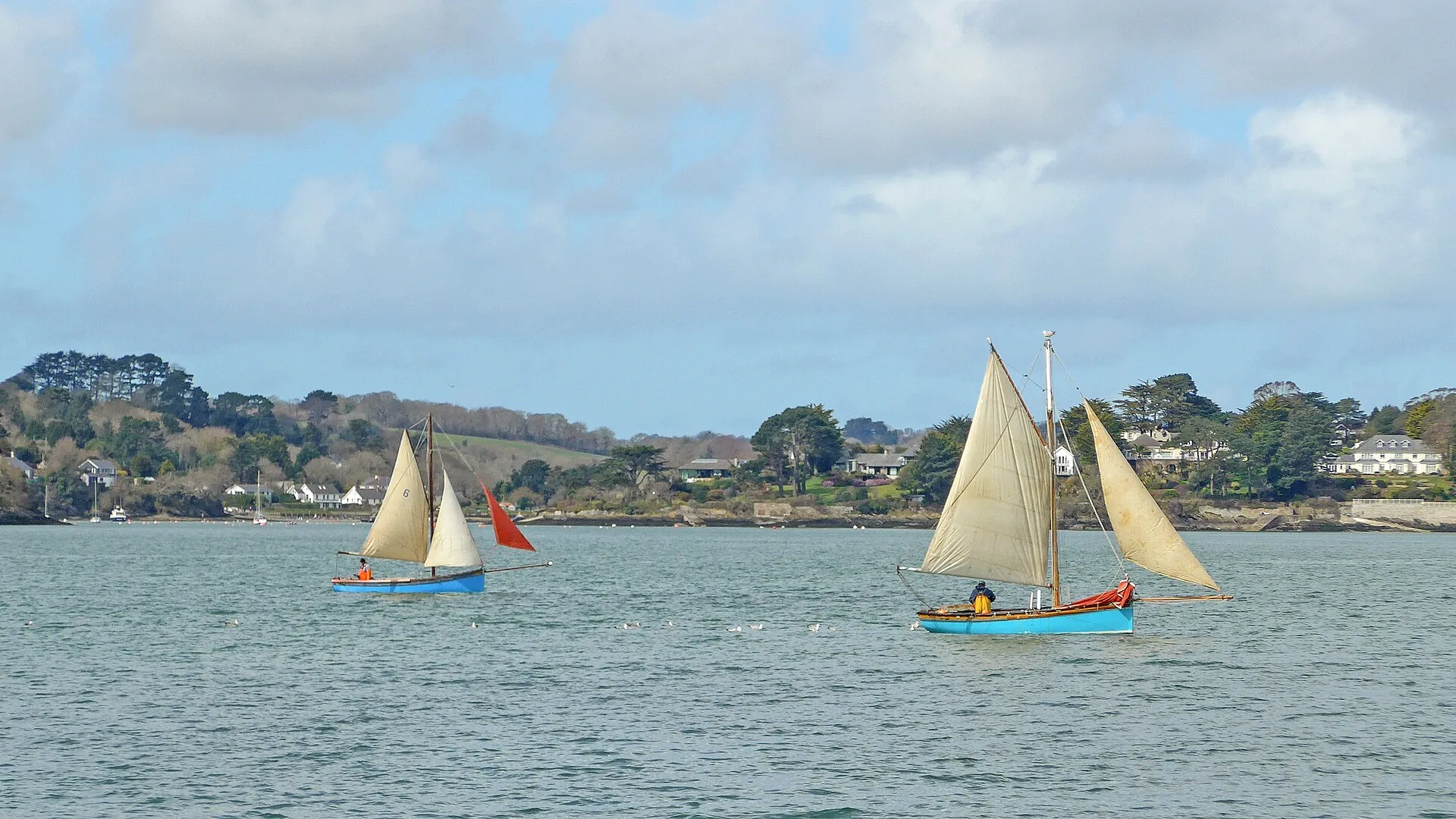
The great advantage of chartering here is the Carrick Roads itself: a broad, deep estuary with land on three sides. When Falmouth Bay is lumpy, the Roads are usually still comfortable, and with the boat to yourselves the skipper can simply stay inside.
Outside the harbour it depends on the wind. The bay is most exposed to winds from the south and east; the prevailing south-westerlies are partly blocked by the Lizard peninsula. Where the tide runs out of the estuary against an onshore wind, the mouth between Pendennis Point and St Anthony Head can build short, steep waves even on a sunny day.
Tide matters in the creeks. The upper reaches dry to mud at low water, so the skipper will time a trip into them around high tide. If a particular creek or landing matters to you, mention it when you book.
If anyone in your group is prone to seasickness, read our guide to calm-water trips and avoiding seasickness before you choose a route.
What to bring
- A windproof layer, even in August. It is always cooler on the water than on the quay.
- Soft shoes with grip. Heels and hard soles slip on wet decks and mark them.
- Sun cream, sunglasses and a hat that will not blow off.
- Food and drink, unless the listing says they are provided. Ask whether alcohol is allowed.
- A dry bag or zip-lock bag for phones and car keys.
- Swimming things and a towel if you are hoping for a swim stop.
Our guide to what to wear on a boat trip in Falmouth goes through it by season and by type of boat.

How to book
Charters through the booking link are sold by the boat, with the price, duration, maximum group size and meeting point on the listing. Before you pay, check:
- how many people the boat takes, and whether children count as full places;
- what is included (skipper and fuel should be; food and drink often are not);
- the exact meeting point, and how long it takes to walk there from where you will park;
- the weather and cancellation policy, in writing;
- whether the boat has a cabin or shelter if the forecast is mixed.
Summer weekends and the school holidays book up first. Midweek in May, June and September is easier. Our guide to the best time of year for a boat trip in Falmouth goes month by month.
Opens GetYourGuide in a new tab. We earn a commission if you book, at no extra cost to you. How this site makes money
Common questions
Do we need any boating experience?
No. The skipper handles the boat, the navigation and the safety briefing. Some skippers are happy to let a guest take the wheel for a while in open, quiet water; ask when you book if that matters to you.
Can we bring young children or a dog?
Often yes, but it varies by boat. Check that the operator has life jackets in the right sizes for your children, and ask about dogs before you book rather than on the quay.
What happens if the weather is bad?
The skipper makes the call on the day. In a blow they may keep you inside the sheltered Carrick Roads instead of going out to sea, or offer another date. Read the cancellation terms on the listing before you pay.
Is there a toilet on board?
It depends on the boat. Small open boats and RIBs usually have none, while larger cabin boats and yachts often do. If you are going out for more than a couple of hours with children, ask.